
Approved website content
Published or controlled website information that the organization has designated as valid for the relevant response scope.
Knowledge Control in BasisAssistant
Ground assistant responses in sources your organization has approved, with clear ownership and maintenance responsibilities.
When product information, FAQs, manuals, and internal guidance are spread across different places, teams can lose track of which source is current, which version is approved, and who is responsible for maintaining it.
A knowledge base gives BasisAssistant a defined set of organizational sources to use within an approved scope. Your organization can determine which sources are valid, who owns them, who may view or edit them, and how they are reviewed and updated over time.
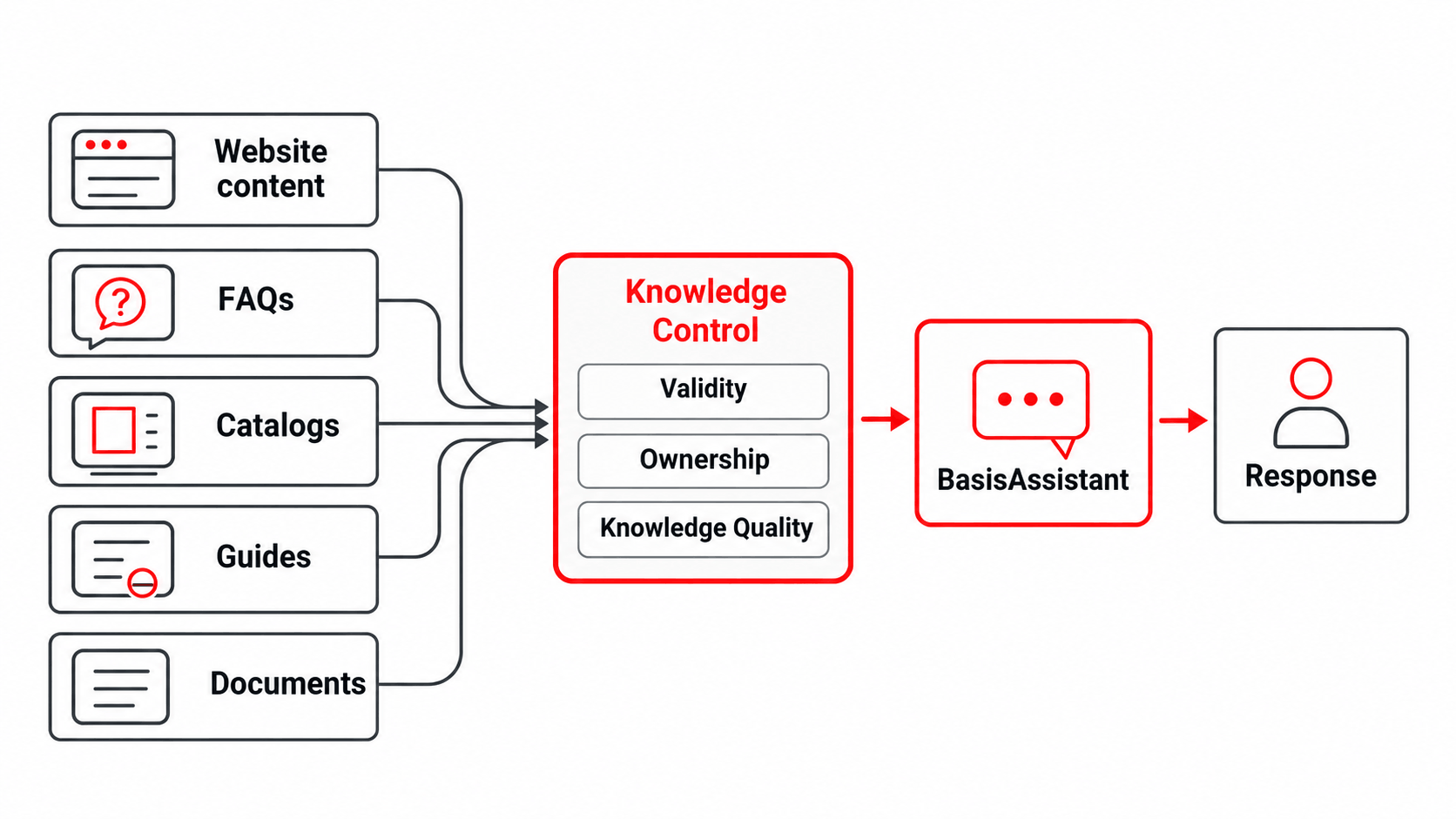
Having information is not enough. The source needs to be valid, usable, and owned by a responsible person or team.
A knowledge base is a structured collection of documents, questions, instructions, and information that an assistant can use when answering. In BasisAssistant, the goal is not to expose every file or content source available to the organization. The goal is to define which sources are approved for use within the intended response scope.
Grounding means tying an AI response to approved organizational sources and data rather than leaving the answer disconnected from the organization's own knowledge. This keeps the response path closer to information the organization has chosen to maintain and gives teams a clearer place to correct or update the underlying source when needed.
Published or controlled website information that the organization has designated as valid for the relevant response scope.
Reviewed FAQs or question-and-answer content that has a known owner and a clear validity status.
Product, service, or organizational information that has been approved as a current reference.
Manuals, usage guidance, procedures, or other instructions that have been reviewed for the intended audience and scenario.
Other documents or information may be included when the organization has explicitly approved them for use and assigned responsibility for maintaining them.
A source type alone does not make information reliable. Before it becomes part of the response basis, its completeness, correctness, freshness, and consistency should be reviewed within the organization's knowledge-control process.
A knowledge base becomes more dependable when responsibility for approval, access, and updates is not ambiguous.
Knowledge governance defines who owns each source, which information is valid, who can view or edit it, how versions and updates are managed, and who approves new or revised information for use. It should also preserve enough change history for review and audit so that outdated, conflicting, or unapproved content does not quietly become part of the assistant's response basis.
| Control | Question to Resolve | Practical Value |
|---|---|---|
| Source owner | Who is responsible for the accuracy and maintenance of this source? | Avoids ownerless knowledge and unclear responsibility. |
| Content validity | Which information and which version are currently approved? | Reduces the risk of using outdated or conflicting versions. |
| Access level | Who may view, edit, or approve the source? | Keeps knowledge access aligned with organizational roles and responsibilities. |
| Version and update | What is the valid version and how often should it be reviewed? | Creates a controlled path for keeping information current. |
| Publication approval | Who allows a new or revised version into the response cycle? | Prevents unreviewed content from becoming an approved response source. |
| Change history | What changed, when, and under whose approval? | Supports traceability and audit when information is revised. |
| Knowledge quality | Is the source complete, correct, current, and internally consistent? | Improves the quality of the knowledge used by the assistant. |
The practical benefit is not only better response control. When an answer needs correction, the team can return to the responsible source, update the underlying knowledge, and keep the change inside a governed maintenance process rather than treating each individual conversation as an isolated fix.
Connecting a source creates value only after its scope, validity, and maintenance responsibility are clear.
Identify the questions, topics, or scenarios the assistant is expected to cover and determine which organizational sources are relevant to that scope.
Review candidate sources for completeness, correctness, freshness, and consistency. Old, duplicate, or conflicting information should be identified before it is treated as approved knowledge.
Assign a source owner, define access and editing rights, identify the valid version, set an appropriate review cadence, and specify who approves updates for use.
Once the source has been approved, it can become part of the knowledge basis for that response scope. Later changes should follow the same ownership, review, and approval controls.
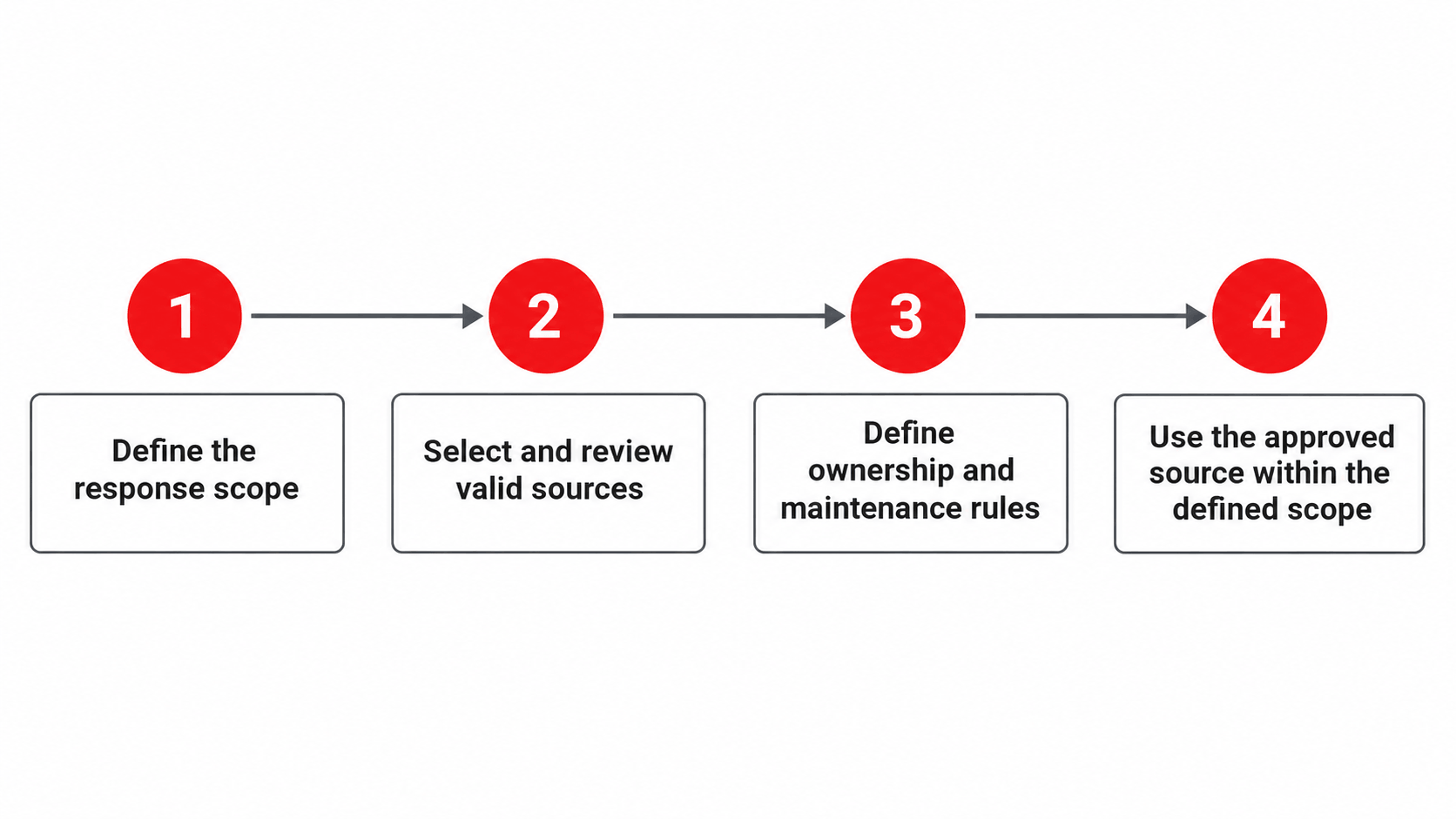
This is a knowledge-management framework, not a claim that every step is automatically executed by the product. The exact connection method, supported formats, synchronization approach, and technical implementation depend on the approved deployment scope and the current official product status.
Knowledge control, answer-source review, and human handoff support the same response journey, but they are not the same capability.
Defines which organizational sources are approved for use and how ownership, validity, access, review, and updates are controlled.
Supports review of the source behind information used in an answer, making it easier for teams to inspect where the response came from and identify the knowledge that may need review or updating.
When the assistant does not have a valid answer within scope, confidence is insufficient, or the request requires human review or a human decision, the conversation can continue through the responsible person or team according to the defined handoff path.
A knowledge base does not make incorrect, incomplete, or outdated information valid by itself. Adding more sources is not a substitute for knowledge QA, clear ownership, or an agreed review and approval process.
A limited scope and a defined source set make knowledge quality easier to evaluate and govern.
The initial knowledge scope does not need to include every document the organization has. A more controlled starting point can be one topic, a limited set of recurring questions, or a defined customer or internal scenario supported by sources with clear responsibility.
Before starting, clarify:
What topic, user need, or response scenario should the first scope cover?
Where are the currently valid sources for that scope?
Who owns and approves those sources?
Which version of each source is valid today?
Who may view, edit, or approve the knowledge?
How are changes reviewed, and who approves a revised version for use?
Which test questions and expected answers will be used for knowledge QA?
Which topics should remain outside the assistant scope or move to a human review path?
This supports a Land-Validate-Expand approach: start with a clear and manageable knowledge scope, validate the quality and governance process, and expand only after the first scope is working as intended.
A knowledge base is a structured collection of documents, questions, instructions, and information that the assistant can use when answering. For this page, the important control is that the organization identifies which sources are valid and permitted for the intended response scope.
Approved website content, reviewed FAQs, catalogs or official product and service information, guides, instructions, and other permitted organizational documents or information can be part of the knowledge base. The source type alone is not enough; its validity and maintenance responsibility should also be clear.
No. Knowledge quality depends on factors such as completeness, correctness, freshness, and consistency. Old, duplicate, or conflicting information should be identified and controlled rather than added without review.
Each source should have a defined owner or responsible team. That responsibility includes maintaining accuracy, identifying the valid version, reviewing content at an appropriate interval, and following the agreed approval path when information changes.
The knowledge base defines which sources are approved for use and how those sources are owned, reviewed, accessed, and updated. Answer Citations & Sources focuses on reviewing the source behind information used in an answer, so teams can inspect the origin of the response.
The assistant should not fill a knowledge gap with an unverified definitive answer. If the question is outside the approved scope or needs human review or a human decision, it should follow the defined handoff policy to the responsible person or team.