Deployment & Integration Services

Custom AI Assistant Development & Deployment

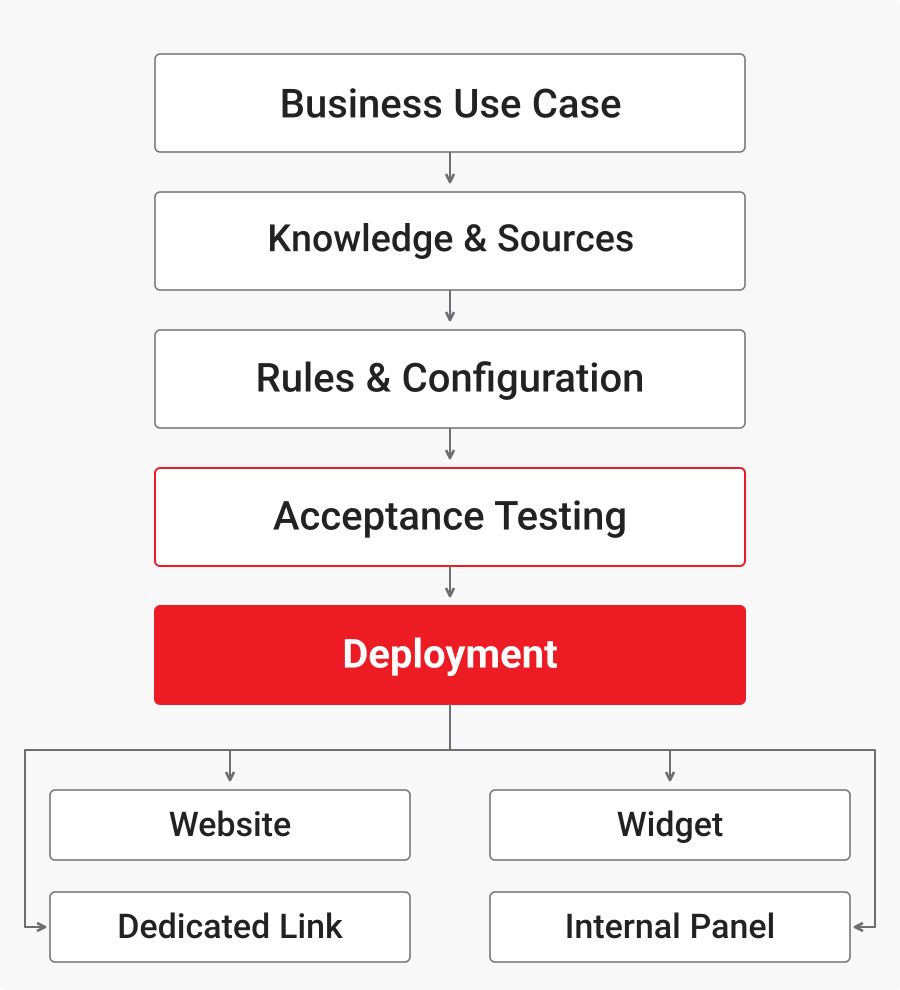
Configure BasisAssistant around a defined business use case, with the knowledge, response rules, and deployment channel your organization needs.

If you already know what the assistant needs to do and have the required data ready, you can move directly into deployment.

We define the project scope, prepare the required knowledge structure, and configure BasisAssistant around the approved requirements. After internal testing and customer acceptance testing, the assistant is launched on the agreed channel. A pilot is not a mandatory prerequisite for this service.

View a Sample Assistant
BasisAssistant configuration journey from defining the business use case and preparing knowledge to acceptance testing and deployment

When Should You Move Directly to Deployment?

If the problem, use case, and core data are clear, a pilot is not a mandatory first step.

This service is designed for organizations that already know how the assistant will be used and have the information required to begin. In that situation, the project can move directly into project-scope definition and BasisAssistant configuration.

If the problem, data, or success criteria still need validation, a limited pilot may be a better first step before full deployment. The difference is project readiness: a pilot validates the use case; this service delivers an agreed deployment.

  • Move directly to deployment: The use case is defined and the required data is ready.
  • Start with a pilot: The use case, data, or success criteria still need limited validation.

What Is Included in the Base Deployment Package?

The core process starts with understanding the use case and continues through testing, training, launch, and initial monitoring.

The base package follows a defined framework, while implementation details can vary with the use case and the size of the organization. At the beginning of the project, we establish what the assistant is expected to do, which knowledge and rules it will use, and how the deployment will be evaluated.

BasisAssistant is then configured around those decisions. This keeps the project boundaries clear and separates the core deployment from new requests that fall outside the agreed project scope.

  • Initial discovery of the business problem and need
  • Define the use case and project scope
  • Review data and content readiness
  • Gather and import the knowledge sources required for the project
  • Design the assistant’s knowledge structure
  • Define response tone and style
  • Define response rules and allowed or restricted topics
  • Design the conversation flow
  • Configure BasisAssistant
  • Set roles and access permissions
  • Deploy to standard channels
  • Run technical and content testing
  • Complete quality assurance and user acceptance testing (UAT)
  • Provide initial training
  • Go live
  • Provide initial monitoring and corrections

Where Can the Assistant Be Deployed?

You do not need to migrate your existing website simply to start this service.

BasisAssistant can be deployed on one standard channel or across a combination of approved channels, depending on the project. If your current website stays in place, the assistant can be added without requiring a full website migration.

Deployment across multiple websites or domains can also be provided within the standard deployment framework. When a website widget or connection code is used, Manzoomeh Negaran handles its installation as part of this service.

  • Existing website
  • Website widget
  • Dedicated link
  • Subdomain
  • Standalone chat page
  • Internal panel

What Needs to Be Ready Before the Project Starts?

Good configuration depends on reliable information and clear ownership on the customer side from the start.

Deployment is not only a technical task. Your organization needs to provide reliable sources, the required access, and the people responsible for project decisions so that the assistant’s knowledge, rules, and acceptance criteria are based on approved information.

  • Assign a project owner
  • Assign a knowledge owner
  • Assign a technical contact when required
  • Provide reliable source material
  • Provide the required access
  • Provide API access when a separately scoped integration is part of the project
  • Define the use case
  • Define users and roles
  • Define success criteria
  • Participate in required project meetings
  • Complete user acceptance testing
  • Provide final approval

How Does the Project Move from Definition to Launch?

Each stage produces the information or approval needed to move into the next one.

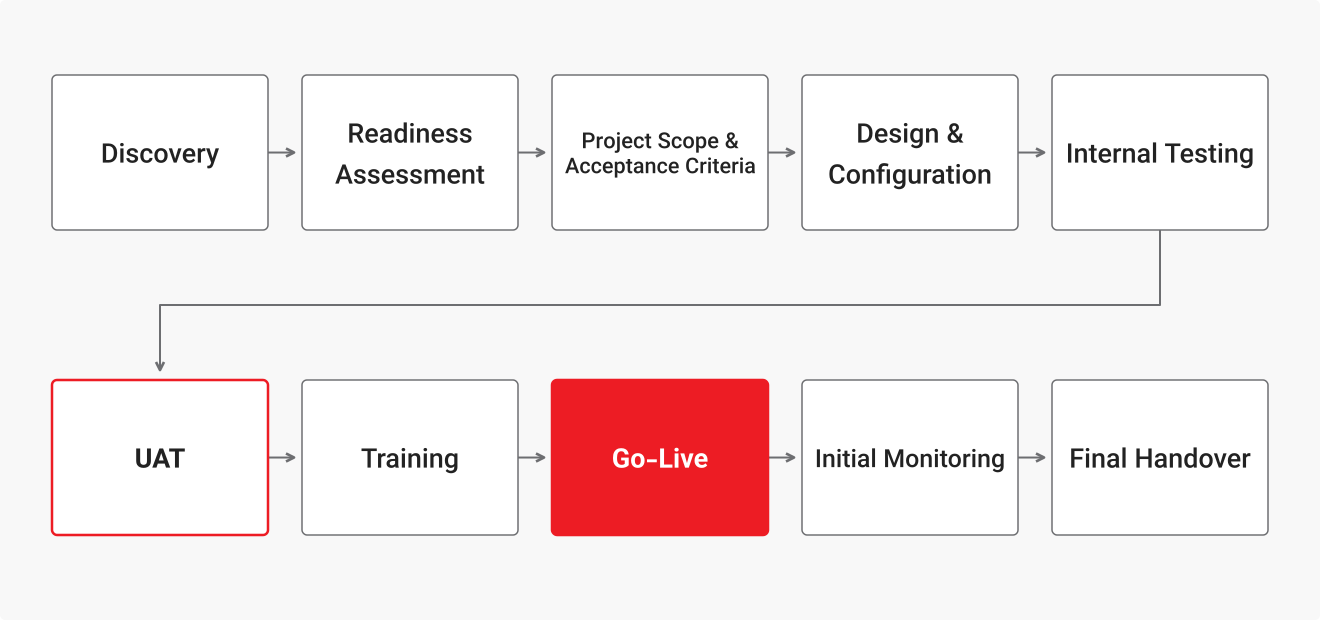
The project follows a staged process. We first review the business problem and organizational readiness. We then define the project scope and acceptance criteria before design and configuration begin. The assistant is tested internally and then reviewed by the customer before launch.

  1. Discovery

    Define the problem, use case, and people responsible for the project.

  2. Readiness assessment

    Review the required knowledge sources, data, access, and other project inputs.

  3. Project scope and acceptance criteria

    Define what will be delivered and how it will be approved.

  4. Design and configuration

    Prepare the knowledge structure, response rules, conversation flow, roles, and required settings.

  5. Internal testing

    Review technical and content behavior before customer testing.

  6. User acceptance testing

    The customer reviews the agreed scenarios and acceptance criteria.

  7. Initial training

    Train the responsible users on the relevant parts of the deployment.

  8. Go-live

    Launch the assistant on the approved channel.

  9. Initial monitoring

    Review early operation and make corrections that fall within the agreed project scope.

  10. Final handover

    Close the project against the approved project scope and acceptance criteria.

BasisAssistant deployment process from business discovery and readiness assessment through acceptance testing, launch, and final handover
Customer acceptance testing takes place before go-live.

Who Is Responsible for What During the Project?

The customer provides the required information and approvals; Manzoomeh Negaran carries out the agreed deployment work.

Responsibilities are separated from the beginning so both sides know which information and approvals must come from the customer and which activities are part of Manzoomeh Negaran’s implementation work.

Customer responsibilities

  • Assign a project owner, knowledge owner, and technical contact when required
  • Provide reliable source material and the required access
  • Define the use case, users, roles, and success criteria
  • Participate in required project meetings
  • Complete user acceptance testing
  • Provide final approval

Manzoomeh Negaran responsibilities

  • Deliver the agreed standard service scope
  • Design and configure the assistant
  • Prepare the knowledge structure within the agreed project scope
  • Deploy to the approved channels
  • Perform testing and quality assurance
  • Provide initial training
  • Complete go-live
  • Provide initial monitoring and corrections

When Is the Assistant Ready for Launch and Handover?

Activating the assistant is not enough; the acceptance criteria for the project must first be reviewed.

Customer user acceptance testing is required before go-live. The assistant is considered ready for launch when the acceptance criteria relevant to the agreed project scope have been reviewed and accepted.

A separate written sign-off for go-live is not a universal requirement. However, the user acceptance testing outcome and the agreed acceptance criteria must be confirmed before launch.

  • Respond according to the project’s approved knowledge sources
  • Follow the agreed tone and response rules
  • Follow the approved conversation flows
  • Capture information correctly where data capture is part of the project scope
  • Operate correctly on the approved deployment channel
  • Respect configured roles and access permissions
  • Review Human Handoff or integration behavior only when those items have been added through a separate project scope or statement of work

Standard deliverables

  • Configured BasisAssistant
  • Administrative access
  • Project knowledge structure
  • Approved deployment channel
  • Website widget or dedicated link when applicable
  • Role and access settings
  • Test report
  • User acceptance testing report
  • Basic documentation
  • Initial training
  • Handover report

Conditional deliverables

A Human Handoff path and other work outside the base package are included only when they have been defined under a separate project scope or statement of work.

Which Services Are Separate from the Base Package?

Work outside the base project scope is reviewed, defined, and priced separately.

The base package on this page is designed for configuring and deploying BasisAssistant. Some requirements are project-specific or development-specific and are therefore handled separately rather than being automatically included.

The BasisAssistant subscription is also separate from the development and deployment fee. Integration, custom development, and long-term support are priced separately. No fixed project price is stated on this page.

Item
Status
Base development and deployment package
Included in the standard scope
Initial training
Included in the standard scope
Initial monitoring and corrections
Included in the standard scope
Human Handoff flow design
Separate statement of work
Additional training
Separate from the base package
Custom documentation
Separate from the base package
Integration
Separate from the base package
Custom development
Separate from the base package
Long-term support
Separate service or package
BasisAssistant subscription
Separate from the development and deployment fee
New work outside the agreed project scope
Change request with separate pricing

How Are Project Timing and Support Defined?

Project timing depends on the actual project scope, available resources, and deployment conditions.

A fixed public delivery timeframe is not stated for this service. The implementation timeline is defined after reviewing the project scope, available resources, deployment channels, and integration requirements.

Data readiness, required access, and customer participation can also affect the schedule.

Initial monitoring and support after go-live are included in the standard package. Long-term support is provided separately. No general public service-level agreement (SLA) is stated for this service; support terms and any applicable service levels are defined in the project scope or contract.

What Should You Know Before the Project Starts?

The quality of the outcome depends on reliable sources, a clear project scope, and active participation from both sides.

A custom assistant is more dependable when it works with reliable knowledge, clear rules, and a defined area of responsibility. For that reason, this service is delivered within clear project boundaries.

  • Response quality depends on the quality and accuracy of the customer’s approved source material.
  • Healthcare, legal, financial, and human resources use cases are only offered after assessment and project-scope definition.
  • The assistant does not replace professional human judgment in sensitive matters.
  • Specific business results, sales outcomes, or a defined number of leads are not guaranteed.
  • Integration depends on valid API access and the technical access required by the target system.
  • Changes outside the agreed project scope are reviewed separately.
  • Project timing depends on data readiness and customer participation.
  • Project-specific service levels and other special requirements are defined in the project scope or contract.
Frequently Asked Questions About Custom AI Assistant Deployment

Do we need to run a pilot before deployment?

No. If the use case and required data are already defined and ready, you can move directly into the development and deployment service. A pilot is useful when the problem, data, or success criteria still need limited validation.

Is the assistant built from scratch for every customer?

No. This service is for configuring and deploying BasisAssistant around a defined customer use case. Custom development or new product capabilities are not part of the base package and are reviewed separately.

Do we need to migrate our existing website to deploy the assistant?

No. Website migration is not a general requirement for this service. BasisAssistant can be deployed on your existing website. Standard deployment options also include a website widget, dedicated link, subdomain, standalone chat page, or internal panel.

Can the assistant be deployed across multiple websites or domains?

Yes. Deployment across multiple websites or domains can be provided within the standard deployment framework. The required channels are defined in the project scope.

Is Human Handoff included in the base package?

No. Designing the Human Handoff path is handled under a separate statement of work. If it is added to the project, the relevant testing criteria and deliverables are defined as part of that work.

Is integration with our CRM or other software included in the base package?

No. Integration is outside the base package and is reviewed separately. Whether a connection can be implemented also depends on valid API access and the technical access available for the target system.

How long does the project take?

A fixed public delivery timeframe is not stated for this service. The implementation timeline is defined after reviewing the project scope, available resources, deployment channels, and integration requirements.

Is the development and deployment fee the same as the BasisAssistant subscription?

No. The BasisAssistant subscription is separate from the development and deployment fee. Integration, custom development, and long-term support are also priced separately.

What support is provided after go-live?

Initial monitoring and support after go-live are included in the standard package. Long-term support is provided separately. Any applicable service-level commitments are defined in the project scope or contract.

Can the assistant be used for sensitive use cases?

Healthcare, legal, financial, and human resources use cases are only offered after assessment and project-scope definition. In these areas, the assistant does not replace professional human judgment.

See a Sample Assistant in Action

Before deciding on deployment, open Manzoomeh Negaran's AI chat and see a sample of the type of interaction a custom assistant can provide.

View a Sample Assistant

See a sample assistant conversation and get a clearer sense of the type of interaction this service is designed to configure and deploy.