
Teams with recurring customer questions
For teams where a significant share of calls or messages covers the same subjects and reliable answers already exist in company-approved sources.
AI Solution for Customer Service
Handle repetitive questions with approved knowledge, send cases that need human judgment to the right person, and evaluate the support flow with clear metrics.
Support teams often spend a significant part of their time answering similar questions, finding reliable information, and manually directing requests. This can slow the first response and make follow-up harder for both customers and support staff.
AI Customer Support connects the initial response to sources your organization has approved. If a reliable answer is not available, the request falls outside the defined scope, or human judgment is required, the case moves to the responsible person for further review.
You can begin with one clearly defined support scenario. Review answer quality, in-scope resolution, and human handoff before deciding whether the scope should expand.
Review your support scenario, approved knowledge, and human handoff path in a demo.
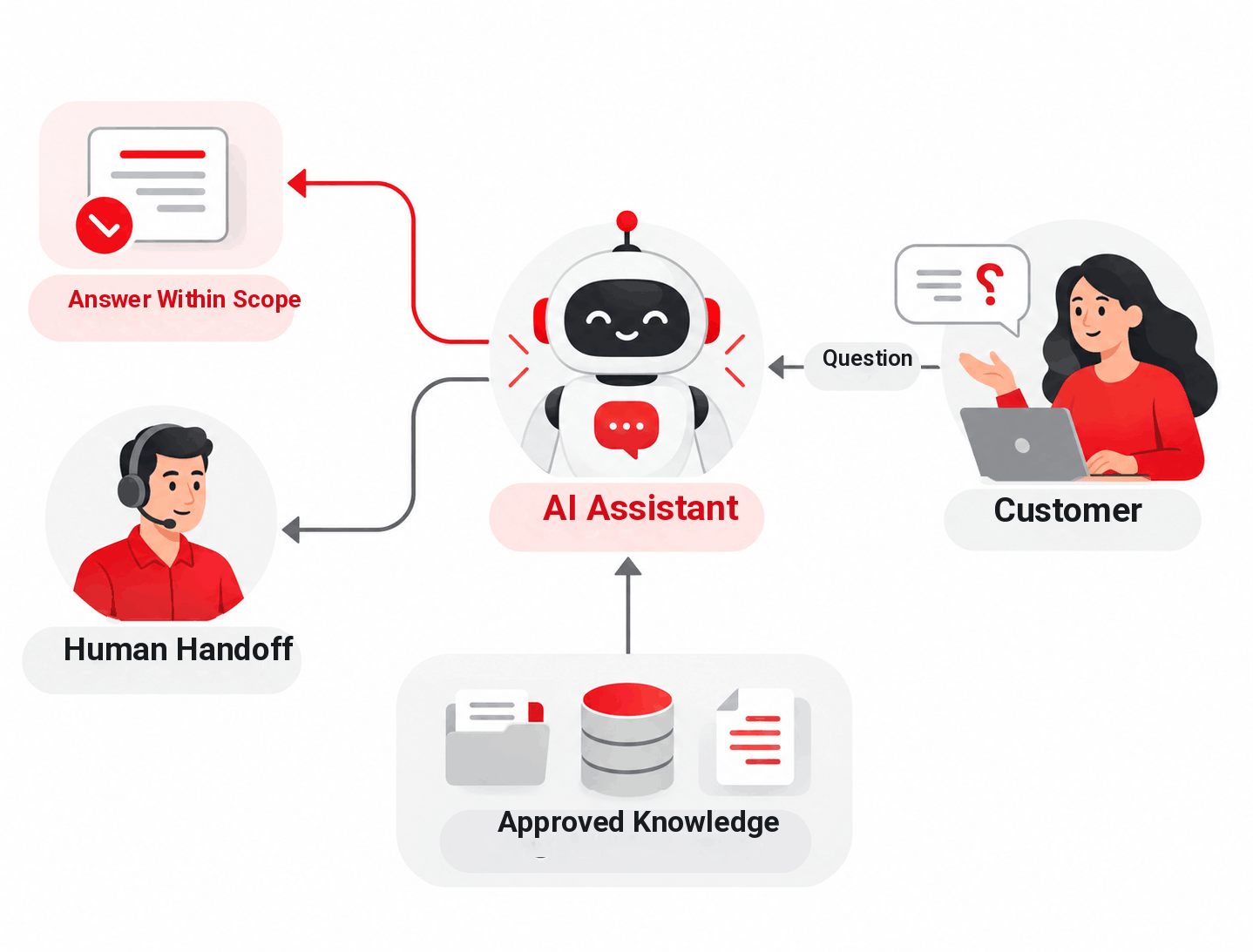
The challenge is not only the number of messages. Scattered information and inconsistent routing also make support harder to manage.
Many support conversations begin with similar questions: how to use a product, what a service includes, which documents are required, the status of a request, or which team should handle the next step.
When those answers are spread across website pages, files, and individual team members, finding reliable information takes longer. Responses can also depend too heavily on who happens to answer, while customers may need to repeat the same context as their request moves between people.
Common signs of this problem include:
AI customer support is not designed to remove the human role. Its purpose is to make the initial response, context collection, and handoff more structured within a clearly defined scope.
The strongest fit is a defined support problem backed by reliable knowledge, clear ownership, and measurable outcomes.
For teams where a significant share of calls or messages covers the same subjects and reliable answers already exist in company-approved sources.
For organizations that need to identify the type of request, collect initial details, and direct the case to technical support, warranty, service, or another responsible team.
For businesses where accurate answers depend on guides, service information, product documentation, policies, catalogs, or approved FAQs.
For situations where some questions have clear answers, while sensitive, complex, uncertain, or out-of-scope cases still require a person.
For support leaders who want to review first response time, in-scope resolution, human handoff rate, and customer satisfaction for a defined scenario.
The solution is a better fit when the organization has a clear owner for support knowledge, a responsible person or team for follow-up, and agreed metrics for reviewing the result.
The process starts with a defined scope and approved knowledge, then moves to a human specialist whenever the case requires one.
This solution is delivered through BasisAssistant. BasisAssistant is an AI-powered sales and customer support assistant for website interactions that can guide users, capture leads, and connect sales or support to the next action. In this support scenario, the focus is on approved responses, request context, and the correct next step.
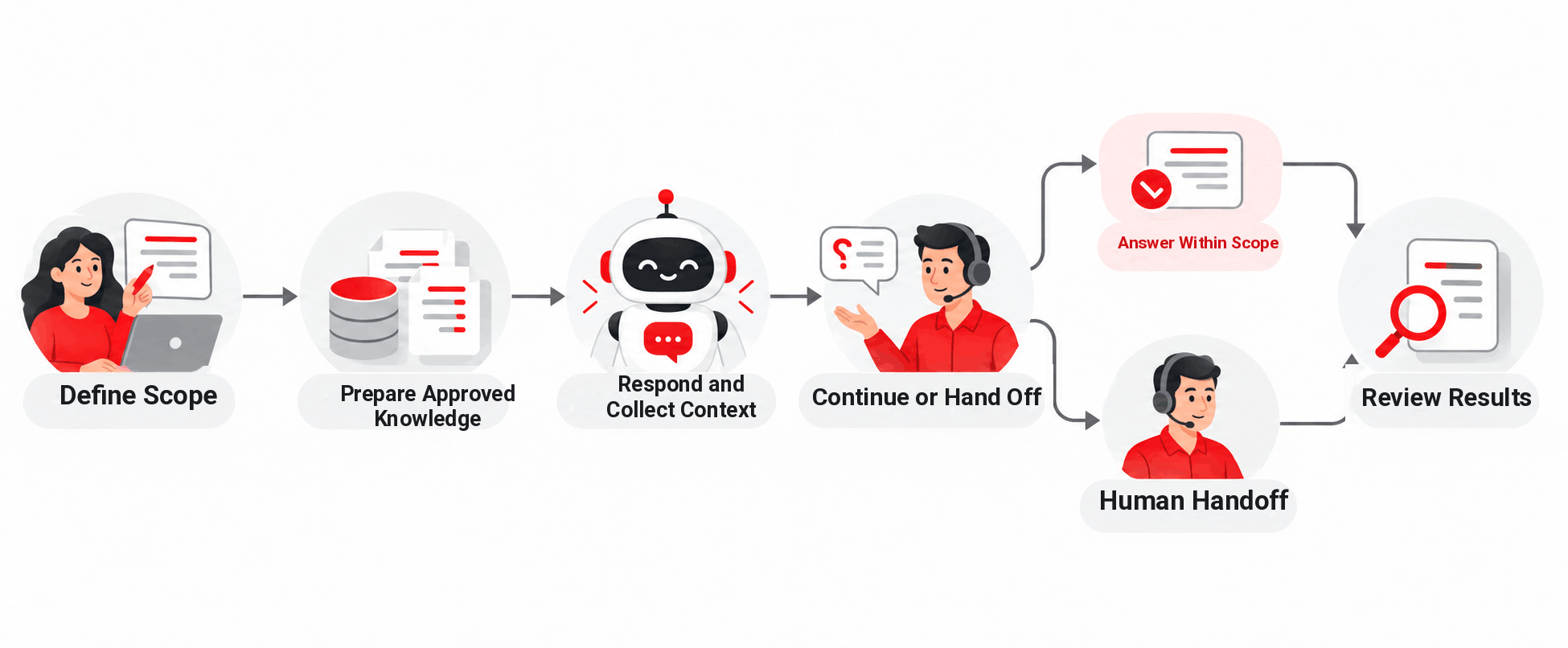
Decide which questions the assistant should handle, what information it may need to collect, and which subjects must remain outside its scope.
FAQs, service information, guides, and other reliable materials are organized through Knowledge Base & Approved Sources. The organization should also define who is responsible for approving and updating that knowledge.
The assistant responds within the agreed scope. When necessary, it collects the basic information needed to understand the request and support the next step.
If no reliable answer exists, the subject is outside the defined scope, or the request requires human judgment, Human Handoff transfers the case to the responsible person or team.
Sample responses, in-scope resolutions, handoffs, and customer feedback are reviewed to determine whether the scenario needs refinement or whether the scope is ready to expand.
Each scenario should be defined around a specific type of request, trusted information, and a clear follow-up path.
The assistant can provide an initial answer when the information is available in approved company sources. Questions that fall outside those sources move to further review.
A short sequence of clear questions can help identify the general nature of the request and direct the customer toward the appropriate support or service path.
Before a case moves to a specialist, the assistant can collect information such as the relevant product or service, request type, and an initial description of the issue. The specialist can then continue with better context.
Requests with a clear, approved answer can follow one path, while cases that require investigation, coordination, or human judgment are separated for further handling.
If ticketing is included in the approved deployment scope, request details can be passed to the ticketing path for logging and follow-up. This connection is not assumed for every deployment and must be defined separately.
The quality of the solution depends on reliable information, clear response boundaries, and active ownership inside the organization.
Without reliable content, a knowledge owner, or someone responsible for follow-up, the risk of poor answers and incomplete handoffs increases. The solution should not be presented as delivering a guaranteed result without those inputs.
Metrics should be selected before deployment and should match the support scenario being evaluated.
How long it takes the customer to receive the first relevant response to their request.
The share of requests that receive an appropriate answer within the defined scope without requiring further human review.
The share of conversations transferred because no reliable answer was available, the case was too complex, or human judgment was required.
A review of sample responses for alignment with approved sources, clarity, and relevance to the customer’s question.
Customer feedback on the answer, the handoff process, and the overall support experience.
These are evaluation metrics, not general performance promises. Target values, the measurement period, and the calculation method should be defined for the specific demo, pilot, or deployment.
Clear limits are part of a well-designed support flow.
A good starting point has trusted knowledge, clear ownership, and metrics you can actually review.
You do not need to replace the entire support process or migrate the current website to begin. One group of recurring questions or requests can be selected and evaluated within a controlled scope.
A practical initial scope includes:
After reviewing answer quality and the handoff flow, the organization can decide whether to add new topics, expand the knowledge base, or connect the solution to AI Assistant + Ticketing. This keeps expansion based on real use rather than on a long list of capabilities that may not yet be needed.
No. The solution is intended to handle initial responses, collect context, and guide recurring requests within a defined scope. Sensitive, complex, uncertain, or decision-dependent cases should still move to a human specialist.
Answers should come from sources approved by the organization, such as FAQs, service information, guides, and relevant documentation. The organization should also assign responsibility for reviewing and updating those sources.
Handoff rules are defined for each support scenario. Common reasons include the absence of a reliable answer, an out-of-scope subject, a sensitive request, or a case that requires human judgment.
No general website migration or full support-system replacement is required to begin with a limited scenario. Any technical change or system connection should be defined according to the scope of the specific deployment.
No. Initial responses and human handoff can be evaluated within a limited scenario first. Ticketing can be added when the business need, destination system, required access, and follow-up path have been defined.
Relevant metrics can include first response time, in-scope resolution rate, human handoff rate, answer quality, and customer satisfaction. Target values and the measurement method should be defined for the specific demo, pilot, or deployment.