
- Content and media: The structure of copy, images, files, and metadata.
- URLs and SEO: Existing URLs, including high-traffic or commercially important pages where relevant, and their redirect requirements.
- Forms and data: Fields, stored information, and compatibility with the target structure.
- Users and roles: Accounts, roles, and access levels.
- Schemas and fields: Data structures and source-to-target field mapping.
- Integrations: Dependencies on APIs, connectors, or other services.
- Access and permissions: Available access, information ownership, and permission constraints.
- Cutover and rollback: Final transition conditions, backup requirements, and the defined rollback path.
Deployment & Integration Services
Migration Assurance
Move a website or data with a defined scope, clear control points, and a planned rollback path.
Migration involves more than moving copy and files. Existing URLs, content, media, forms, users, roles, access permissions, and software integrations can all be affected when a website or system moves.
Migration Assurance provides a controlled path from inventory and classification through dry run, user acceptance testing, cutover, and post-migration monitoring. The objective is a migration that can be reviewed and managed, not an absolute guarantee of outcome.
Request Readiness Report
Clarify migration scope, risks, and control points before the final migration decision.
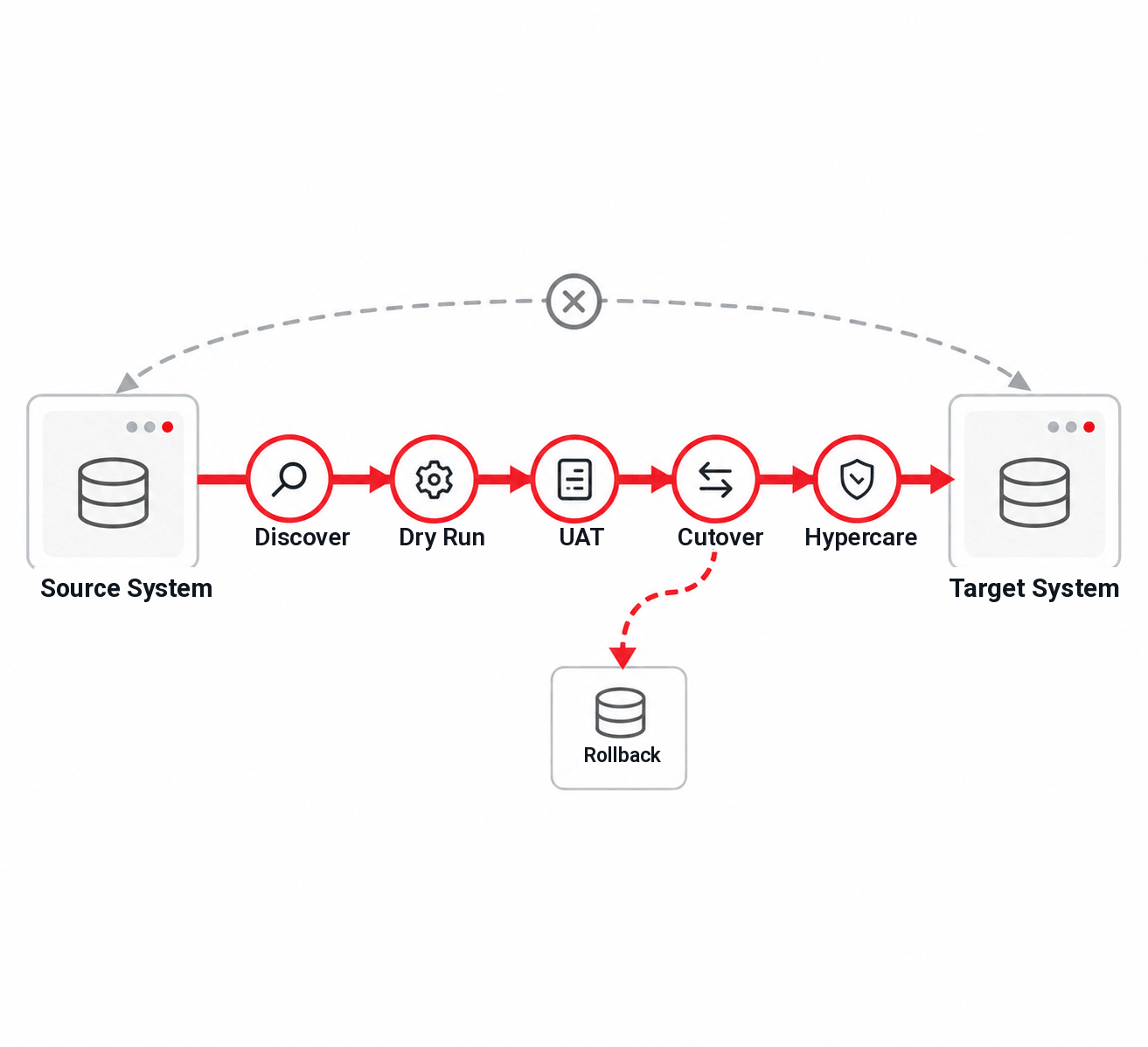
Migration Is More Than Content Transfer
Unchecked dependencies can surface during cutover.
Moving a website or data can affect several parts of the business at the same time. Content and files may reach the target system while URLs, forms, user access, or software connections no longer match the new structure.
Before execution, the project needs a clear view of what will move, what requires adjustment, and what should remain outside the migration scope.
The migration assessment reviews:
The Standard Scope of Migration Assurance
The final scope is defined after assessment and documented in the Statement of Work.
Migration Assurance is a standalone service designed to reduce risk when moving a website or data. Its documented controls include inventory, redirects, dry runs, backups, rollback planning, and user acceptance testing.
The exact scope depends on the source, target, data quality, available access, and project dependencies. Not every item requires the same migration method.
Inventory
Content, media, URLs, forms, users, roles, fields, and relevant integrations are inventoried.
Classification
Each item is classified for automated, semi-automated, or manual migration, or for exclusion or archiving.
Mapping
Source and target structures are mapped across URLs, media, users and roles, forms, fields, schemas, and integrations.
Preparation
Required cleanup is completed, and a sandbox environment, backup, and sample dataset are prepared where needed.
Dry Run
A test migration is performed so the result can be reconciled and exceptions identified before final cutover.
UAT
Content, processes, SEO, access, and reporting are reviewed through user acceptance testing.
Cutover & Rollback
Final cutover conditions and the rollback path are defined before go-live.
Hypercare
The migrated environment is monitored after cutover, in-scope exceptions are addressed, and the final migration status is documented.
An Eight-Stage Migration Process
Each stage adds a control before the project moves forward.
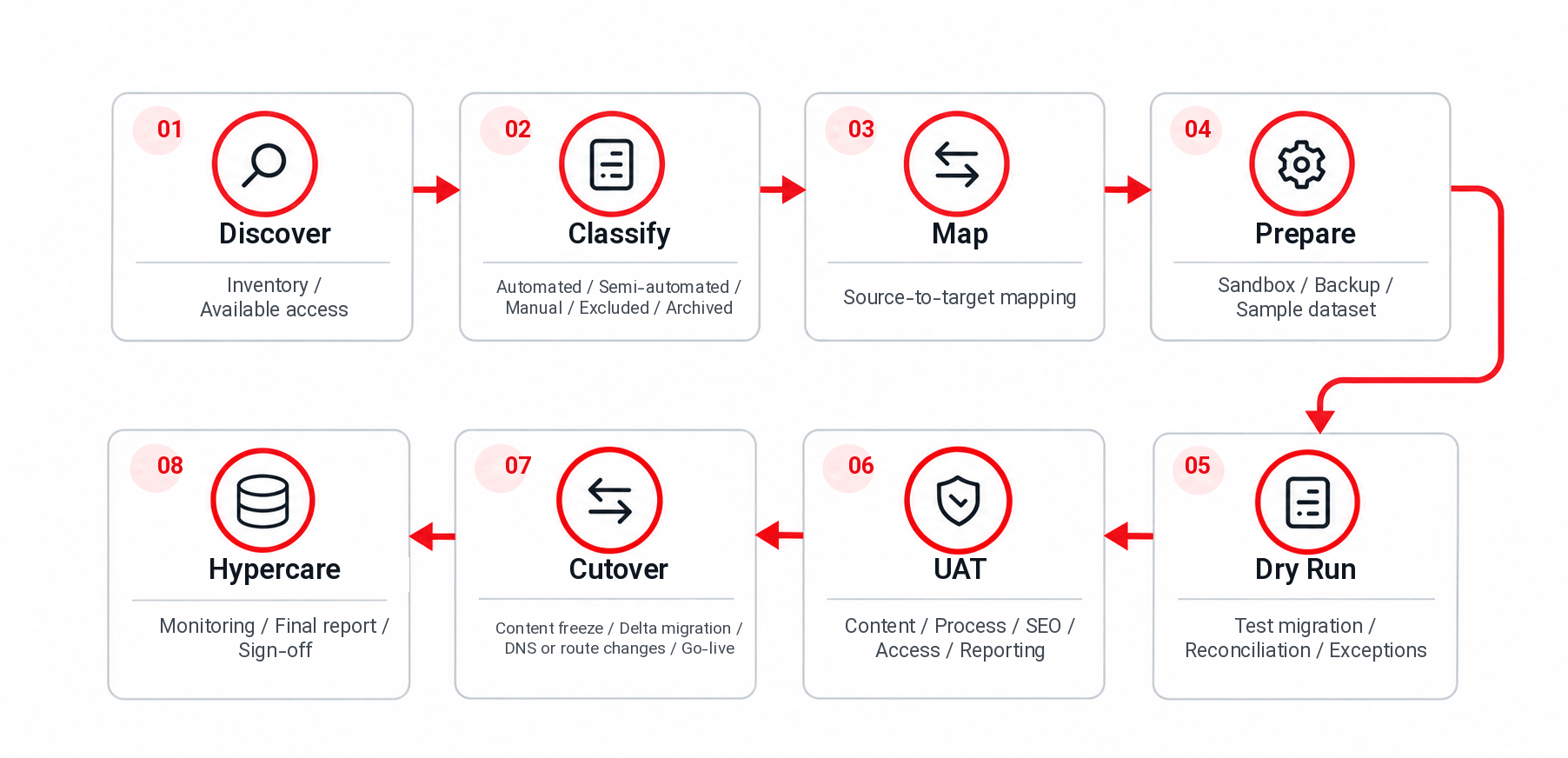
Stage 1 - Discover
Review the inventory, available access, data volume and quality, ownership, and licensing or permission constraints.
Stage 2 - Classify
Determine whether each item should be migrated automatically, semi-automatically, manually, excluded, or archived.
Stage 3 - Map
Map forms, users and roles, media, URLs, fields, schemas, and integrations between the source and target environments.
Stage 4 - Prepare
Complete required cleanup and prepare the sandbox, backup, and sample dataset.
Stage 5 - Dry Run
Run a test migration, reconcile the result, and record exceptions.
Stage 6 - UAT
Perform user acceptance testing across the agreed content, process, SEO, access, and reporting scenarios.
Stage 7 - Cutover
Execute the content freeze, delta migration, DNS or route changes, and go-live according to the approved plan.
Stage 8 - Hypercare
Monitor the migrated environment, address in-scope exceptions, complete the final report, and record sign-off.
Which Roles Need to Be Defined?
A controlled migration needs clear ownership for decisions, data, technical review, and acceptance.
Migration readiness depends on more than technical access. The project also needs clear ownership for decisions, information, implementation, and acceptance.
Sponsor / Decision Owner
Supports the business objective, budget, and key project decisions.
Data or Content Owner
Identifies which information is valid and helps resolve incomplete, duplicated, or out-of-scope items.
Technical Owner / Approver
Provides required technical access and clarifies source-system constraints, integrations, and dependencies.
System Owner
Represents the internal owner of the system and supports operational adoption, change, and day-to-day use.
UAT / Customer Owner
Reviews the agreed business scenarios and records acceptance sign-off.
Implementation Manager
Coordinates the implementation plan, dependencies, control points, risks, and documented project outputs.
The exact ownership of each deliverable, approval authority, and contractual responsibility is defined in the project Statement of Work or implementation documentation.
What Is Reviewed for Migration Readiness?
A useful readiness report must reflect the real condition of the source, target, and project ownership.
Migration inputs vary by project. The following items are reviewed where relevant, and missing information can be recorded as a constraint or risk:
- An initial inventory of content, data, files, URLs, and media
- Valid access to the source system or usable source exports
- Data volume and quality
- The identified data, content, or system owner
- Access and licensing or permission constraints
- High-traffic URLs and commercially important pages, where relevant
- Available analytics or Search Console information, when relevant to URL and SEO review
- Form, field, and schema structures
- Users, roles, and required access levels
- Relevant integrations, APIs, and connectors
- Target structure or target requirements
- Backup availability
- The need for a sandbox or sample dataset
- Agreed scenarios for user acceptance testing
This review does not mean every identified item will automatically be migrated. The migration method and status of each item are established during classification and mapping.
Project Deliverables and Acceptance
A migration is not complete simply because data has been moved.
Depending on the approved scope, project outputs can include:
- Readiness Report: Current readiness, major constraints, and identified risks
- Scope & Risk Register: Approved scope and documented project risks
- Inventory: The items reviewed for migration
- Migration Plan / Master Deployment Document: Migration stages, dependencies, and control points
- Redirect Plan: Approved handling of in-scope URLs
- Backup & Rollback Plan: The backup approach and defined recovery path
- Dry Run Results: The outcome of the test migration
- Reconciliation & Exceptions: Comparison results and recorded exceptions
- UAT Record: Results of content, process, SEO, access, and reporting review
- Runbook: The execution path for cutover and go-live
- Final Report & Sign-off: Final migration status, remaining exceptions, and recorded acceptance
Before cutover, the agreed business scenarios must be reviewed and signed off by the customer owner. Project-specific acceptance criteria, reconciliation targets, and allowed exceptions are defined for that migration rather than assumed as universal values.
The Boundaries of Migration Assurance
A controlled process is not the same as an absolute guarantee.
Migration Assurance means the migration is planned, controlled, and reviewable. It does not guarantee that every type of data will move without exception, or that search rankings, traffic, or search-engine behavior will remain unchanged.
The main service boundaries are:
- Migration scope must be defined in a separate Statement of Work.
- Only items included in the approved scope enter the migration process.
- Reconciliation targets, allowed exceptions, and acceptance criteria must be defined for the individual project.
- Transfer feasibility depends on the source structure, target structure, available access, and data quality.
- Incomplete, inconsistent, or inaccessible data may require separate action.
- URL, SEO, and redirect controls are part of migration planning, but they do not guarantee unchanged rankings or traffic.
- Backup and rollback conditions must be defined for the actual project scope.
- Custom API, connector, or integration development is not part of the standard Migration Assurance service.
- Custom Integration requires separate Discovery, a Statement of Work, and Change Control.
- Data export and the exit process must be addressed in the applicable contract.
- No universal migration timeline or price is stated on this page; both depend on the assessed scope, volume, complexity, and applicable commercial agreement.
- Website migration is not a general prerequisite for starting with BasisAssistant.
These boundaries keep the public promise aligned with the actual project scope, contract, and delivery controls.
Migration Assurance FAQ
Does Migration Assurance guarantee the outcome of a migration?
No. Migration Assurance means the migration is planned, controlled, and reviewable. Scope, control points, dry run, UAT, and rollback conditions are defined before final cutover, but the service is not an absolute guarantee of outcome.
What can be reviewed as part of the migration scope?
Depending on the project, the review can cover content, media, URLs, forms, fields, schemas, users, roles, and integrations. The migration method and status of each item are established during classification and mapping.
What is a dry run?
A dry run is a test migration performed before final cutover. The result is reconciled against the expected migration outcome, and exceptions are recorded before the production move.
What role does UAT play in migration?
UAT, or user acceptance testing, reviews the agreed content, process, SEO, access, and reporting scenarios. The customer owner reviews the agreed business scenarios and records sign-off before cutover.
How are URL and SEO risks handled?
In-scope URLs are reviewed and their redirect handling is defined as part of migration planning. SEO is also reviewed during UAT. These controls reduce migration risk, but they do not guarantee unchanged rankings or traffic.
When can rollback be used?
Rollback depends on the backup, recovery point, and conditions defined before cutover. Its exact scope and availability are determined for the individual migration project.
Is custom integration included in Migration Assurance?
No. Integration dependencies are reviewed during assessment and mapping, but custom API or connector development requires separate Discovery, a Statement of Work, and Change Control.
Do we need to migrate our website before using BasisAssistant?
No. BasisAssistant can be introduced without requiring a website migration. Migration Assurance is used when moving a website or data is genuinely part of the approved project scope.
Clarify Readiness Before You Migrate
A readiness report helps define migration scope, data condition, dependencies, risks, and control points before the final migration decision.
Request Readiness Report
Clarify migration scope, risks, and control points before the final migration decision.