
Capture Essential Information
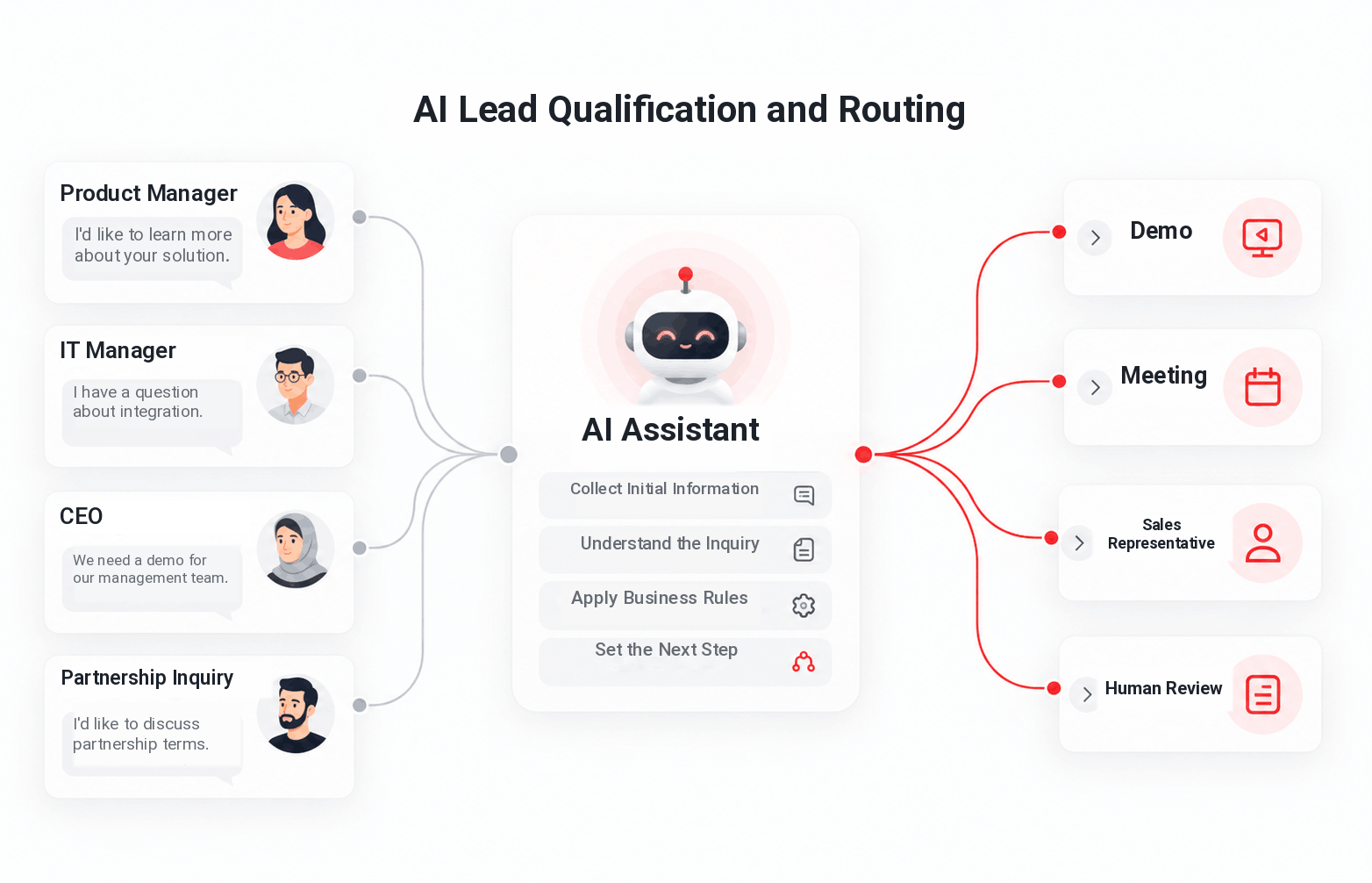
Collect contact details, the subject of the inquiry, the relevant product or service, and the initial context needed by the sales team.
AI Sales Solution
Collect the information you need in the first conversation, assess each lead against defined criteria, and route it to the right sales path.
When every sales inquiry enters the same path without enough context, sales teams spend valuable time collecting basic information, understanding the request, and finding the right person to follow up.
This solution helps capture contact details, the prospect’s need, and the context required for initial qualification. The lead can then be reviewed against criteria defined by your business and routed to the appropriate demo, meeting, salesperson, team, or follow-up process.
The goal is not to replace the sales team’s judgment. It is to give the right person better information and a clearer starting point for the next conversation.
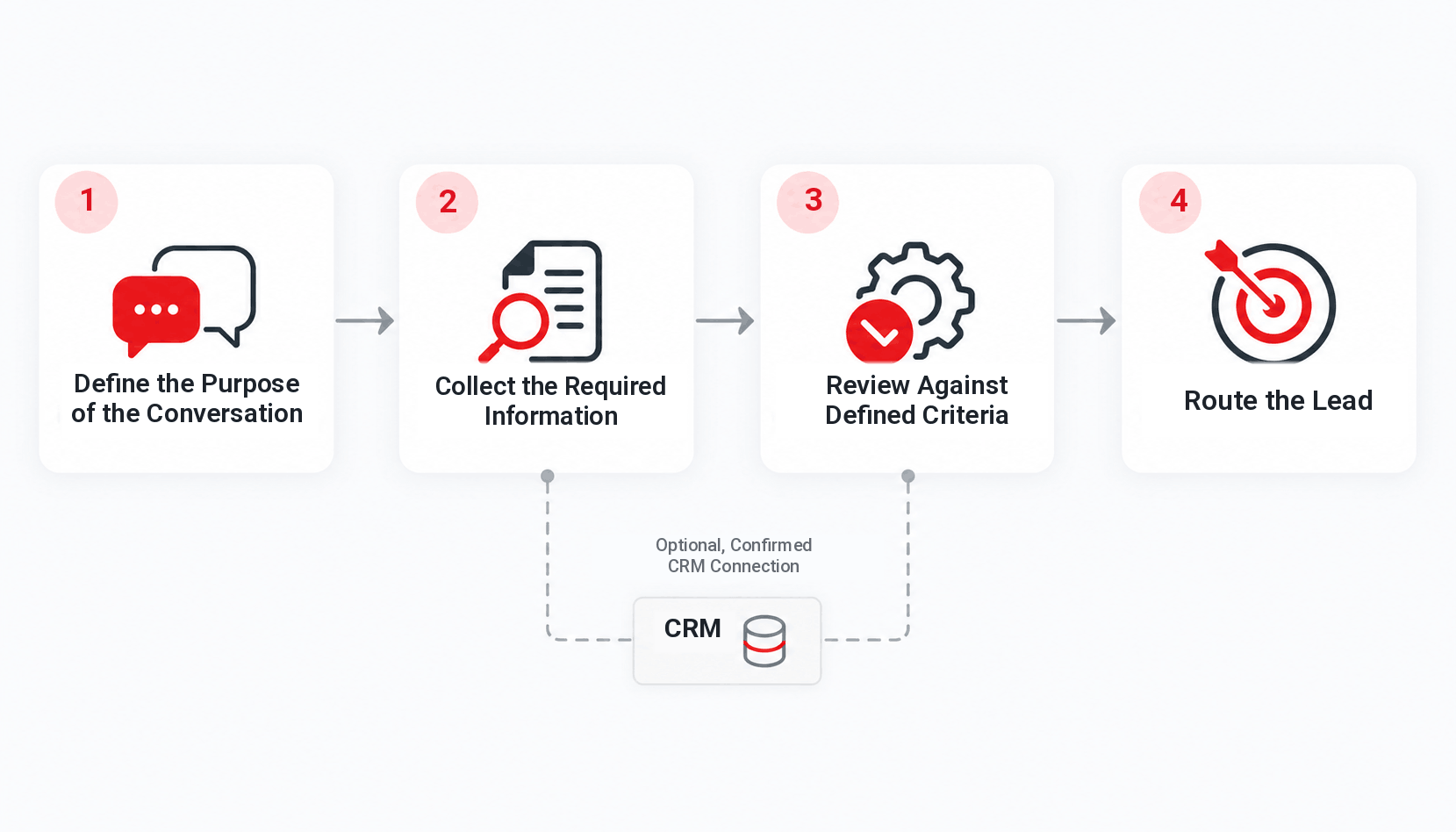
A CRM or other business-system connection is only included when the relevant integration has been confirmed and its data scope has been defined.
See how lead information, qualification criteria, routing, and human review can work in a scenario based on your sales process.
More inquiries do not automatically create a better sales process when information is incomplete and the next step is unclear.
In many businesses, anyone who sends a message or shares contact details enters the same general queue. At that point, the team may still not know whether the inquiry is a good fit, what the prospect actually needs, or who should take ownership.
Salespeople then have to collect basic information before they can begin the real conversation. When an inquiry is incomplete or reaches the wrong person, follow-up takes longer and the prospect may have to repeat the same information.
Common signs of this problem include:
The purpose of this solution is not to increase the number of messages. It is to make each inquiry easier to assess and more practical for the sales team to follow up.
Each conversation should end with enough context and a clear next action.
This solution is built around BasisAssistant. During the conversation, it can capture the contact details, subject of the inquiry, and initial information needed for sales follow-up.
Your business defines the qualification rules. Lead quality should not be determined using vague or unapproved criteria.
Collect contact details, the subject of the inquiry, the relevant product or service, and the initial context needed by the sales team.
Review the information against criteria that have been defined and approved by the business.
Route the lead to the relevant demo, meeting, salesperson, team, or approved follow-up process.
Pass the available context into the next stage so the responsible person can continue the conversation with a clearer understanding of the inquiry.
The questions, qualification criteria, and routing destinations should be defined before implementation.
Start with a clear sales objective, such as a demo request, product inquiry, sales question, or meeting request. The information required should reflect that objective.
Capture the information needed to understand the inquiry and determine the appropriate next step. The information requested should remain relevant to the sales scenario.
Review the lead against the approved qualification criteria. If the information available is not enough to support the intended sales decision, the inquiry should follow the defined human-review path rather than being treated as fully qualified.
Route the lead to the appropriate team, salesperson, demo, meeting, or follow-up process based on its characteristics and needs. Information is transferred to another business system only when the relevant connection has been confirmed.
Qualification criteria should be defined by the business before the solution is implemented.
Review whether the lead fits the conditions your business has defined for sales follow-up.
Clarify the need or business requirement behind the inquiry.
Where budget is part of the approved qualification process, use it as one of the factors considered before further sales effort.
Identify whether the relevant decision-making role has been established for the opportunity.
Understand how urgent the request is and whether its timing supports further sales follow-up.
These five factors are documented qualification criteria. They do not all have to be used in every sales scenario. The final rules should reflect the qualification model approved for that business.
A defined sales scenario with focused information and a clear next action is the strongest place to start.
Use qualification and routing to separate demo or meeting requests and direct each lead to the appropriate sales path.
Use the prospect’s stated need and approved product or service information to guide the inquiry toward the relevant sales path or specialist.
For Private & Corporate Training, the documented scenario includes course guidance, initial level assessment, qualification, and applicant follow-up.
For Professional Services & Compliance, the documented context includes intake, incomplete documents, qualification, proposal-related work, and case follow-up.
For Food Manufacturing & Distribution, documented scenarios include product questions, distributor or agency inquiries, complaints, and sales.
These examples show where the qualification approach can be applied. The exact questions and routing rules should still be defined around the real sales process of each business.
Reliable qualification depends on clear rules, usable information, and clear internal ownership.
Define what type of inquiry, customer, or need should be considered suitable for further sales follow-up.
Define the questions that are necessary for the qualification decision. They should be focused and relevant to the next action.
Clarify what information may be collected during the initial interaction and what information should not be requested in that flow.
Define the destination for each relevant outcome, such as a demo, meeting, product specialist, regional salesperson, later follow-up, or human review.
Each lead category should have a clear owner. The solution cannot resolve unclear internal responsibility by itself.
Define when an ambiguous, sensitive, out-of-scope, or negotiation-heavy inquiry should move to the responsible person.
If information needs to move into a CRM or another business process, confirm the required fields, destination, ownership, and actual connection status before implementation.
The solution prepares an inquiry for better follow-up; it does not replace human sales judgment or negotiation.
This solution is not a replacement for the sales team. BasisAssistant can capture initial information, support qualification against defined criteria, and route the inquiry to the appropriate next step. Negotiation and final commercial decisions remain with the responsible people.
The solution can begin without requiring a full website migration or a replacement CRM. CRM integration should only be introduced when the connection status, required fields, and ownership responsibilities have been confirmed.
The main boundaries are:
If the primary requirement is to complete information, collect documents, or prepare a case before specialist review, Request Intake & Evaluation addresses that problem more directly.
Targets should be set only after the current process has been measured using real business data.
Measurement should show whether the qualification flow is helping prospects complete the required information, identifying qualified leads, and moving appropriate leads toward the defined sales meeting.
| Metric | What It Shows |
|---|---|
| Completion Rate | The share of users who complete the information required by the qualification flow. |
| Qualified Leads | The number or rate of inquiries that meet the approved qualification criteria. |
| Meeting Rate | The share of qualified leads that reach the meeting defined in the sales process. |
No numerical target or guaranteed percentage is stated on the public page.
No. This solution focuses on collecting initial lead information, supporting qualification, and routing the inquiry. It can begin without replacing the existing CRM. Information should move to a CRM only when the relevant connection, fields, and responsibilities have been confirmed.
The documented qualification factors are fit, need, budget, decision-maker, and urgency. Your business defines which of these factors apply to a particular sales scenario.
The primary role of this solution is initial qualification and routing. A final decision should not be based on undefined criteria, and ambiguous or sensitive inquiries should follow the appropriate human-review path.
Define what qualifies as a suitable lead, the information required for qualification, the available routing paths, the owner of each path, the Human Handoff rules, and any approved product or service information. If another system is involved, its connection status and scope should also be confirmed first.
Not necessarily. BasisAssistant is positioned as an independent entry point and does not require a full website migration as a general condition. The actual deployment approach should remain within the approved scope of the project.
Lead qualification is focused on whether a sales inquiry is worth further sales attention and where it should go next. Request intake and evaluation is more focused on completing the information or documents needed before a specialist review.